
There may be several types of relations between the dimensions divided in “simple” and “complex”. Simple types of relations are as follows:
- Association. There is an association in a pair of dimensions D1 and D2 if n groups, n ≥ 2, can be singled out of a set of members of each of them, and a bijection can be established between these groups which manifests as follows: if a combination of SPMC includes the members D1 and D2, they come in pairs, taken from the corresponding groups of members;
- Full association. There is a full association in a pair of dimensions D1 and D2 if a bijection can be established between the members of these dimensions which manifests as follows: the members D1 and D2 can come in SPMC in pairs and in any combinations;
- Dependence. There is a dependence between dimensions D1 and D2 (D2 depends on D1) if the members of D1 can be divided in two groups of members in such way that if a certain combination from SPMC includes the member from the first group of members D1, the member of D2 in this combination is possible, and if the member of the second group of members D1 is included into the combination, the D2 in such combination is set to the “Not in use” member.
There may be complex relationships specified in a pair of dimensions which are the combinations of a few simple relationships:
- Association and dependence. There is an association and dependence between D1 and D2 if n groups can be singled out of D2, n ≥ 1, and (n + 1) – out of D1 in such way that there is an association between first n groups from D1 and D2, and if the combination of SPMC includes the member from (n + 1) group of D1 members, D2 in this combination is set to the “Not in use” member. Besides, the members from (n + 1) group of D1 members can not be met in other groups of this dimension;
- Association and two-sided dependence. There is an association and two-sided dependence between D1 and D2 if n groups can be singled out of a set of members of each of that dimensions, n ≥ 2, in a such way that if the combination of SPMC includes the member from the first group D1, the D2 in this combination is set to the “Not in use” member, and if the combination of SPMC includes the member from the first group D2, the D1 in such combination is set to the “Not in use” member; herewith, the remaining (n − 1) groups of members of D1 and D2 dimensions form an association;
- Two-sided dependence. There is a two-sided dependence between D1 and D2 dimensions if the following rule holds: in case of SPMC combination includes the member from D1, the D2 in this combination is set to the “Not in use” member, and when the combination includes the member from D2, the D1 the in this combination is set to the “Not in use” member.
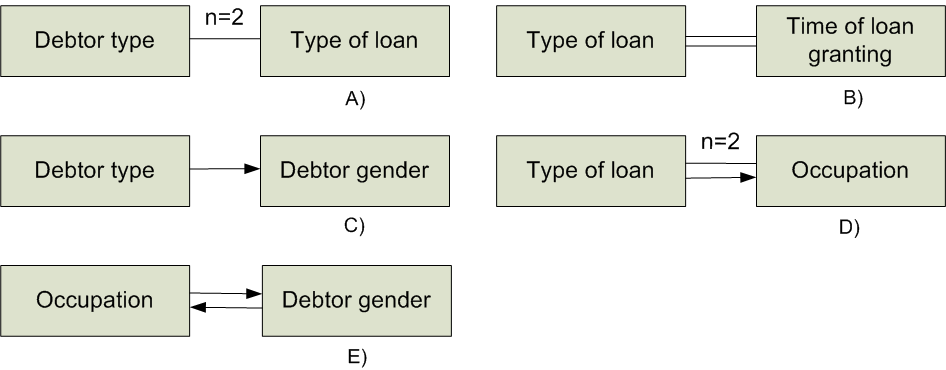
Fig. 1. The types of diagrams describing the pairwise relations between the dimensions: association (A), full association (B), dependence (C), association and dependence (D), two-sided dependence (E)
It is convenient to use the compliance charts of the groups of members for the description of the pairwise relations between dimensions.
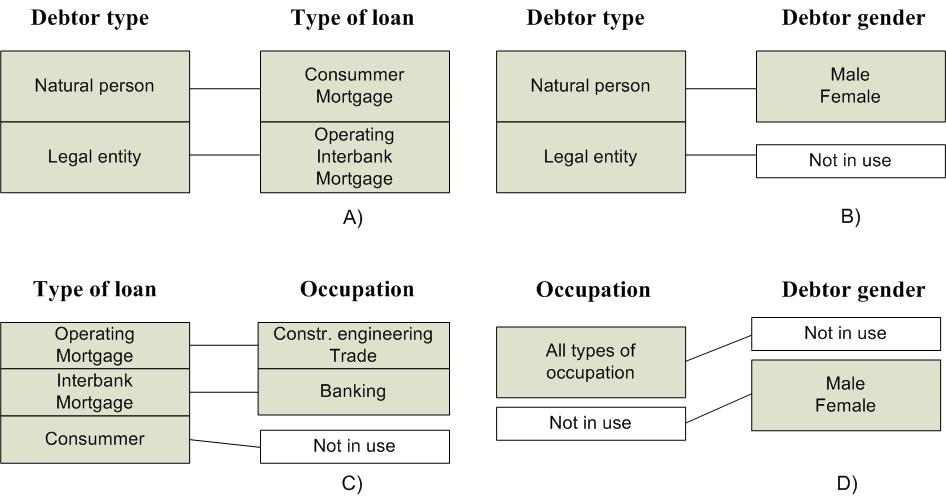
Fig. 2 presents the pairwise compliance charts of the groups for the proposed illustrative example.
Fig. 2. Pairwise compliance charts of the groups of members: association (A), dependence (B), association and dependence (C), two-sided dependence (D)
After building of the pairwise relations between dimensions of the multidimensional cube one can draw a diagram of dimensions connectivity. This diagram should present all dimensions with the indication of all relations between them. On the basis of this diagram the other diagram can be built – a compliance chart for the groups of members which shows the all groups and specifies the relations between them. These diagrams may be used in the formation of SPMC analytical space.
In case of there is a possibility to isolate the subset Li = {Dj1, Dj2, …, Djk} in the dimensions set D(H), there jk is a number of the dimension in the layer, j = 1, …, k, k is a quantity of dimensions in i layer, 1 ≤ k < dim(H), and each dimension of that is completely associated with all dimensions not included into Li, the compatibility of members in Li can be considered independently of other dimensions. Let us call such a subset as “the layer of the dimensions”. The layer of the dimensions, or dimensional layer, is a set of dimensions which members compatibility in SPMC does not depend upon what members in combinations are specified for the dimensions not included into the layer. In case of splitting of a set of analytical space dimensions onto the layers one can build a diagram of dimensions connectivity and generate a set of possible member combinations for each of the separate layers. After the analysis of dimensional layers SPMC can be obtained by the Cartesian product: SPMC(H) = SPMC(L1) × SPMC(L2) × … × SPMC(Lm), there m is a quantity of layers. In the present example there are three layers: L1 ={ Debtor type, Debtor gender, Occupation, Type of loan}, L2 ={Time of loan granting} and L3 ={Place of loan granting}.
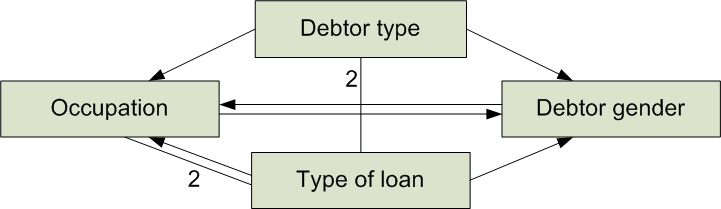
Fig. 3 presents the diagram of dimensions connectivity for the L1 layer from the illustrative example.
Fig. 3. The diagram of dimensions connectivity for the L1 layer
If we analyze some dimension as an element of the diagram of layer connectivity and take into account the relations between the considered dimension and all the rest dimensions of the layer, the groups of members available in this dimension can be transformed so that they will comply with all relations of the considered dimension simultaneously. New groups must lie at the intersection of the groups participating in the description of pairwise relations with different dimensions. Using such procedure one can describe the compatibility of the full set of dimensions in the layer. Let us call such procedure of groups formation as a subdivision of groups of members describing the pairwise relations. When the groups are subdivided the relations between the dimensions revealed at the stage of the pairwise analysis must be inherited.
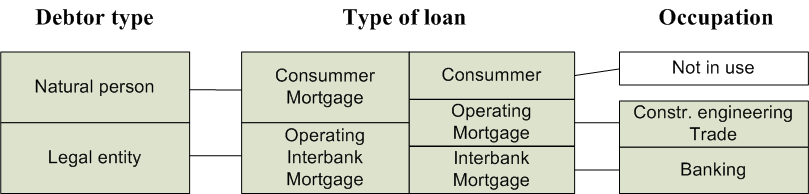
Fig. 4 presents a fragment of the chart of group compliance illustrating the procedure of subdivision of the groups for the dimension “Type of loan”.
Fig. 4. Fragment of the compliance chart of the groups of members for the L1 layer
All pairwise relations from the diagram of layer connectivity are used in the procedure of subdivision of the groups. This complete set of relations allows to distinguish the relations of “Full association” type and relations describing the compliance of the groups which have been already accounted in the remaining relations. These distinguished relations do not influence the result of the groups subdivision and can be removed from the connectivity graph. Thus, the graph can be reduced to a much more simple form without the loss of information about the compatibility of members.
After subdividing the groups describing the pairwise relations between dimensions, one can bypass the compliance chart of the groups of members of the analytical space or the dimensional layer. While bypassing the compliance chart one can reveal the chains of groups of members longwise its relations, and for several dimensions – also the special member “Not in use” instead of the group which members are combined in the SPMC by the “all-to-all” rule. Such chains define a set of combinations included in the SPMC which can be obtained by the Cartesian product of the groups of members and the special member “Not in use” if it is present in the chain. Let us call such set of combinations as the “cluster of member combinations”. Cluster of member combinations is a set of combinations of members which can be obtained by means of the Cartesian product operation in which the operands are the groups of members or the special member “Not in use”, one operand for each of the dimensions, assigned in the multidimensional cube or in the dimensional layer of the multidimensional cube.
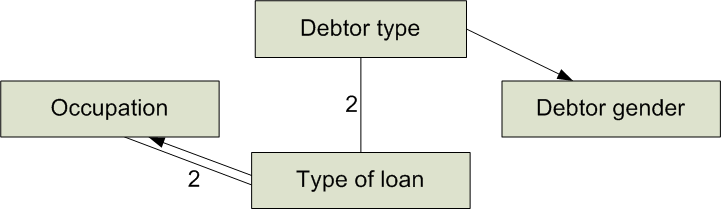
Fig. 6 presents the clusters of member combinations corresponding to the dimensions connectivity diagram for the L1 layer from the illustrative example.
Fig. 5. Reduced dimensions connectivity diagram for the L1 layer
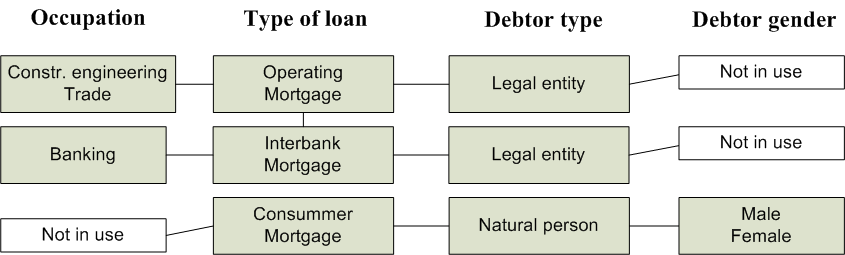
Fig. 6. Clusters of member combinations for the L1 layer
In an absence of subdivision of the dimensions set D(H) onto the layers, SPMC can be represented as the association of clusters corresponding to the compatibility diagram of the analytical space dimensions.
In case of the subdivision of the dimensions set D(H) onto the layers, SPMC for each layer must be built as an association of clusters of member combinations of the layer, and SPMC of the members of multidimensional cube is obtained as a result of the Cartesian product of SPMC for the layers.
There may be a situation when the very different semantic components can be distinguished within the observed phenomenon. In this case it is possible to separately form the subsets of member combinations corresponding to different semantic components. For this purpose it is necessary to analyze the compatibility of members for each component and in accordance with this analysis to form the clusters of member combinations. The SPMC of the members of multidimensional cube can be computed using the set theory operations. Operands in these operations are subsets of member combinations for the components.